On this page
- What does sound design add to a corporate video?
- What does a corporate film include without sound design?
- When is sound design worth paying for?
- When can you skip it?
- How much does sound design cost?
- How do you get better sound before the edit?
- What does a finished mix need for TV, online and events?
- Next step
Sound design is the work that makes a corporate film sound finished: cleaning up the interviews, balancing voices against the music, adding atmosphere and effects, and setting the final volume for wherever it plays. With us, sound design and mixing costs about €500 for a standard film, plus VAT. It pays off whenever people will actually hear the film.
What does sound design add to a corporate video?
Sound design turns recorded audio into a soundtrack that is easy to listen to. Most of it is invisible when it's done well. You notice it when it's missing: an interview that sounds like it was recorded in a stairwell, music that drowns out the speaker, or a film that is far quieter than the one that played before it.
On a corporate film the work usually covers six things:
- Cleaning the dialogue. Removing hum from lights and air conditioning, hiss, clicks, mouth noise and the hard "p" pops that hit a microphone. Taming the echo of a bare meeting room.
- Levelling the voices. Three people interviewed in three rooms never sound the same. A sound designer matches their tone and volume so the film flows from one speaker to the next.
- Fitting the music around the words. The music sits under each sentence and lifts in the gaps, so nobody has to strain to hear a line.
- Atmosphere. A quiet bed of room sound or background ambience fills the gaps between cuts, so the film doesn't drop into dead silence every time the picture changes.
- Sound effects. Small sounds under on-screen graphics, product shots or animated sections make them feel deliberate rather than pasted on.
- The final mix. Setting the overall volume and balance for the place the film will play, from laptop speakers to a conference hall.
It matters more than most people expect. In a 2018 study, people rated identical conference talks and radio interviews less favourably when the audio quality was poor (Newman and Schwarz, Science Communication). Same words, same speaker, lower opinion. Viewers judge the person on screen partly by how they sound.
What does a corporate film include without sound design?
A corporate film from us includes music, colour, captions and titles as standard. On the audio side, that means the sound our cameras record on the day and licensed music, with no further audio work. Our corporate films start from €3,800, plus VAT, for a full day of filming in Dublin and a two to three minute film with supporting shots. Sound design and mixing is one of the extras priced on top, alongside drone footage, motion graphics, stills and social cut-downs.
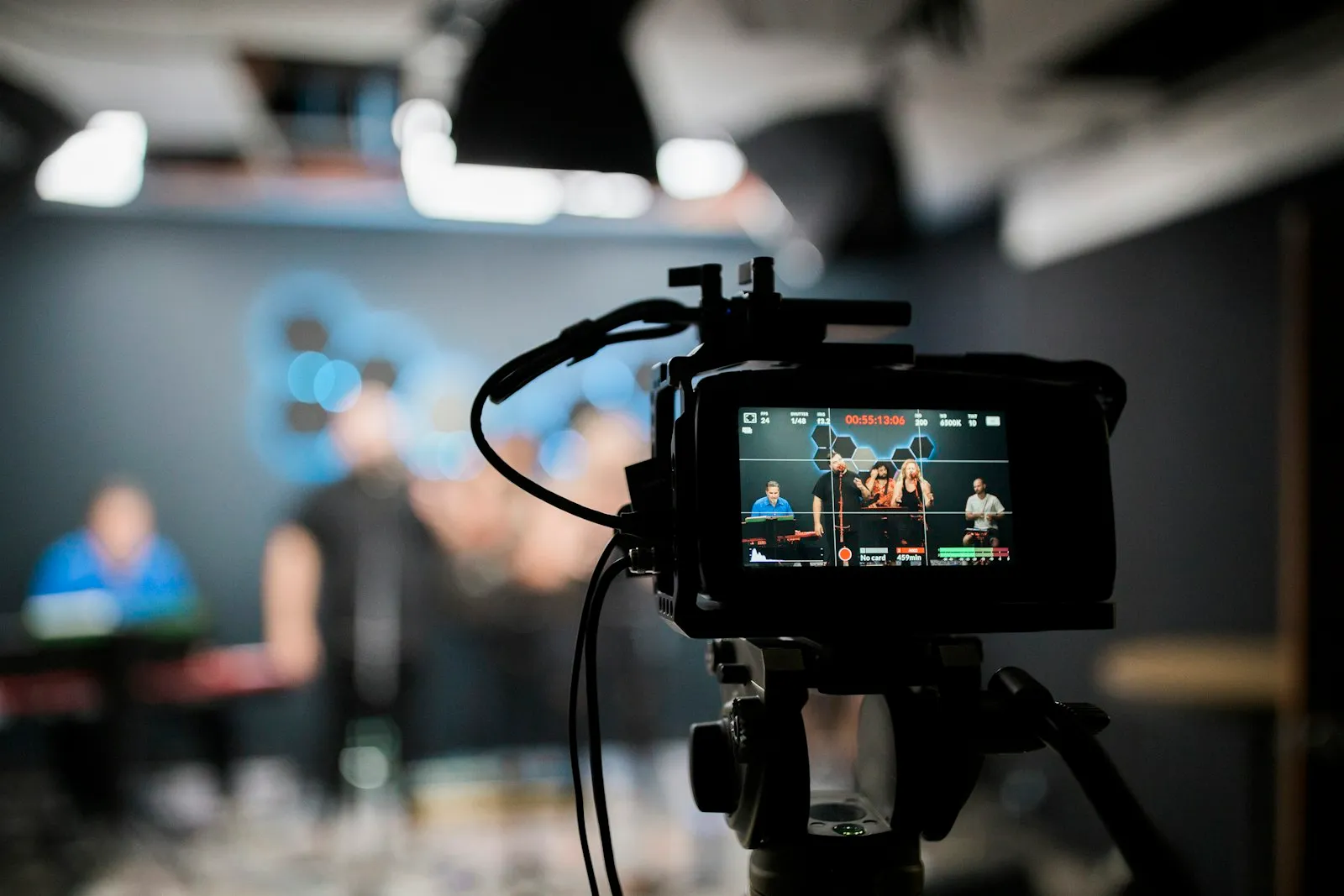
Good sound starts on the shoot day, long before anyone mixes it. On a typical interview shoot our crew of two sets up lights, two cameras and microphones in a quiet room. Our crew records every microphone as a separate file, synced by timecode, which gives an editor or sound designer clean material to work with.
So the question isn't whether your film will have sound. It will. The question is whether it needs the extra pass that makes the sound as polished as the pictures.
When is sound design worth paying for?
Sound design is worth it when people will watch the film with the sound on, in a setting where poor audio would be obvious. These are the cases where we'd point you towards it:
- Films shown on a big screen. A conference opener, an awards night, a town hall or a company all-hands. A large room with a proper speaker system exposes every flaw in the audio, and the film plays in front of everyone at once.
- Your website and pitch films. The film on your homepage or in a sales deck is the one people click to play, usually with the sound on. It's often the first impression a buyer has of your company.
- Adverts that run with sound. TV, cinema, YouTube and audio-on placements need a proper mix, and broadcasters set their own loudness rules (more on that below).
- Animation and motion graphics. Animation has no natural sound of its own. Effects and a careful mix are what make it feel finished.
- Interviews in noisy places. A factory floor, a busy office, a hospital corridor or a windy quayside. If the location fought the microphones, the dialogue clean-up pays for itself.
- Films with a voiceover and music together. Voice, music and effects all compete for the same space. Mixing them properly is the difference between a clear message and a muddy one.
Sound can also be the detail a client notices most. For our anniversary animation for Enet, the client's only notes on the first cut were about the sound, and both fixes came back the next day.
When can you skip it?
You can skip sound design when most people will watch the film without sound, or when the audio is already simple and clean.
Many social feeds start videos muted, and a lot of viewers now read rather than listen. A May 2026 survey of more than 3,000 people in the US, UK, France, Spain and Germany found that 59% of 18 to 24-year-olds use captions always or often. For a short cut-down on LinkedIn or Instagram, the captions do most of the work. Captions come with every edit we make, so those versions work on mute.
Sound design is also hard to justify for:
- Internal updates watched at a desk, such as a quick message from a manager or a project update for the team.
- Simple interview films recorded in a genuinely quiet room, with one voice and a music track and nothing else going on.
- Rough recaps made fast for internal use, where speed matters more than polish.
If you're unsure, ask where the film will spend most of its life. If the honest answer is "in a feed, on mute", spend the money elsewhere, perhaps on an extra cut-down. If it's "on our homepage" or "on the big screen at the conference", sound design is one of the cheapest ways to make the whole film look more expensive.
How much does sound design cost?
Sound design and mixing costs about €500 for a standard corporate film, plus VAT. It's priced per film, and it's quoted up front with everything else.
A bigger figure only comes up for long films. Sound design for a film that runs half an hour or more, such as a documentary, is €1,000–€2,000, plus VAT, because there is far more dialogue to clean and many more scenes to mix. That's rare: most corporate films are a few minutes long.
What moves the price:
- The length of the film. A longer film has more dialogue to clean and more transitions to mix, which is why films of half an hour or more are priced separately.
- The state of the recordings. Clean interviews from a quiet room take less work than audio from a loud location.
- How many elements there are. A film with voiceover, music, effects and several speakers takes longer to balance than one voice over music.
For context, a corporate film with the extras (sound design, motion graphics, drone, stills and social resizes) usually comes to about €5,000–€6,000, plus VAT. The Premium option in our instant quote calculator includes sound design, so you can see both versions side by side. You'll find the other add-ons and what they cost on our extras page.
How do you get better sound before the edit?
The cheapest sound design is good sound on the day. A few things make a real difference:
- Pick the quietest room you have, away from kitchens, lifts and busy corridors. Soft furnishings help; glass walls and bare floors make echo.
- Switch off what hums. Air conditioning, fans and noisy lights are easy to stop for an interview and very hard to remove later.
- Tell the crew about noise you can't control. A fire alarm test, building work next door or a delivery at noon can be planned around if we know.
- Leave time for room tone. Thirty seconds of silence in each room gives the sound designer clean atmosphere to fill gaps.
Our guide to interview video setup goes into how to prepare people and rooms for an interview. If you're choosing music, our post on music and sound design in video branding covers how to choose it and what licensing it needs.
What does a finished mix need for TV, online and events?
A finished mix needs to suit where it plays, because each place handles volume differently.
- Television. Broadcasters set strict loudness rules. In Europe, the EBU R 128 recommendation normalises programme loudness to -23 LUFS, so an advert or sponsored film has to be mixed to the broadcaster's spec before it airs.
- Online. The big video platforms adjust volume themselves, but a mix that's balanced and not overly compressed still sounds clearer on phone and laptop speakers.
- Events. A film for a venue is best checked on the venue's own system before the day, because a mix that sounds right on headphones can sound thin or harsh through a big PA.
If your film will run in more than one place, say so at the start, so the mix is planned for each.
Next step
If you're planning a corporate film, tell us where it will play and we'll tell you honestly whether sound design is worth it. See what's included on our corporate video production page, or get an instant quote with and without the extras.
Written by Mango Media. Published .