On this page
Virtual reality (VR) and augmented reality (AR) are useful marketing tools in specific situations: showing a place or product people can't easily visit, training, and trade-show experiences. They haven't become the future of all video marketing. Few people own headsets, and most marketers still rate VR as one of the least effective video formats.
That's not a reason to ignore them. It's a reason to use them where they solve a real problem, and to start with the simplest version that does the job.
What is the difference between VR and AR?
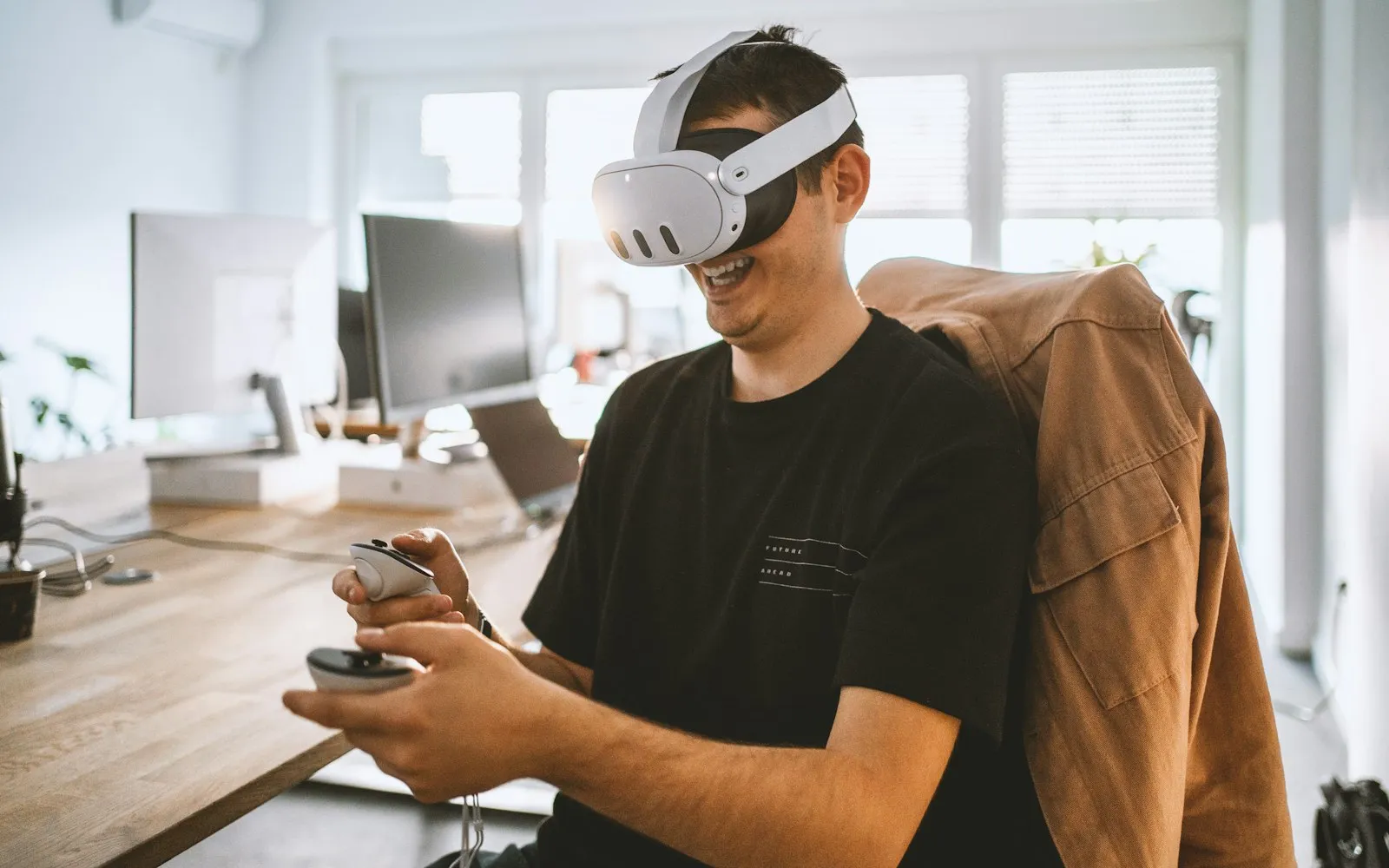
Virtual reality replaces what you see. The viewer wears a headset (such as a Meta Quest or Apple Vision Pro) and is placed inside a filmed or computer-generated scene they can look around, and sometimes move through and interact with.
Augmented reality adds to what you see. Digital objects, labels or effects are laid over the real world, usually through a phone camera. Seeing how a sofa looks in your living room before you buy it is the classic example.
A third format often gets mixed up with both: 360-degree video, which is filmed with a special camera and can be watched by dragging around on a phone or computer, or in a headset. We cover it separately in the benefits of 360-degree video.
How widely are VR and AR used in marketing?
Not very. In Wyzowl's 2026 survey of marketers, 19% had used VR for video marketing, and only 9% rated it effective, which put it near the bottom of the list alongside 360 video and Snapchat (Wyzowl, 2026). By comparison, 82% used YouTube.
The main reason is reach. A VR experience only works for people with a headset, or people you can put in one (at an event, in a showroom, in a training room). AR reaches further because it runs on phones, but building it well needs 3D models and app or web development, not just filming.
Where do VR and AR work well?
- Places people can't easily visit. A walkthrough of a factory, a lab, a construction site or a remote heritage location. Useful for recruitment, investor relations and tourism.
- Training and safety. Practising a procedure, or experiencing a hazard safely. This is where VR has the strongest track record, because the viewer is motivated and the headset is provided.
- Events and trade shows. A headset on a stand gives people a reason to stop, and you control the hardware.
- Seeing products in place. Furniture, fittings, cars and equipment shown at real size in the customer's own space, through a phone. This is mostly AR, built into retailers' apps and websites.
- Property and venues. Virtual tours of buildings, hotels and event spaces, often built from 360 photography rather than full VR.
What happened to AR filters on Instagram?
They became harder for brands to make. Meta closed its Spark AR platform in January 2025, removing third-party AR effects from Instagram, Facebook and Messenger and keeping only Meta's own (Social Media Today). Branded lenses are still possible on platforms such as Snapchat and TikTok, but the "just make an Instagram filter" route that older guides recommend has gone. It's a reminder that AR built on one platform's tools depends on that platform's plans.
What does a VR or AR project involve?
More than a normal shoot. Depending on the format:
- Filmed VR or 360 video needs a 360 camera, careful planning (there's no "behind the camera" to hide crew and kit), slower pacing and spatial audio.
- Interactive VR needs 3D artists and developers to build the environment and interactions in a game engine, plus testing on each headset.
- AR needs accurate 3D models of your product, a way to deliver them (an app, a web AR viewer or a social platform) and testing across phones.
Costs vary widely with scope, so get a specific quote. For filmed content, the factors are the same as any shoot: days on location, crew, editing time and the number of versions.
What should you try before committing to VR?
Ask what you want the viewer to feel or understand, then pick the simplest format that gets there.
- A well-made conventional film of the place, shot with care, often does the job and reaches everyone.
- A 360 video on YouTube lets people look around without a headset (YouTube Help).
- Drone and walk-through footage gives a strong sense of a site's scale and layout.
- Animation can show what's inside a machine or how a process works more clearly than VR. See animation and explainers.
If VR is right, plan for where the headsets will be, who will help people use them, and how you'll measure results.
Are VR and AR the future of video marketing?
They're part of it, not all of it. Headsets are improving and AR is built into more phones and apps, so both will keep growing in specific uses. But for most businesses, most of the time, the films that drive results are still ones people can watch anywhere without special equipment. See video marketing trends for 2026 for where the growth is.
Next step
If you want to show a place, product or process in a way people remember, start with our instant quote calculator, which emails an estimate within minutes, or read about interactive video as a lighter alternative.
Written by Mango Media. Published , updated .