
In today’s oversaturated inboxes, getting your email noticed — let alone opened — is no easy feat. In this article, we’ll explore the power of video in email campaigns, how to embed video content the right way, best practices to maximise performance, and how to track your results. Whether you’re a startup, marketer, or creative agency, using video in your emails can be a game-changer for audience retention and conversions.
What Is a Video Distribution Strategy?
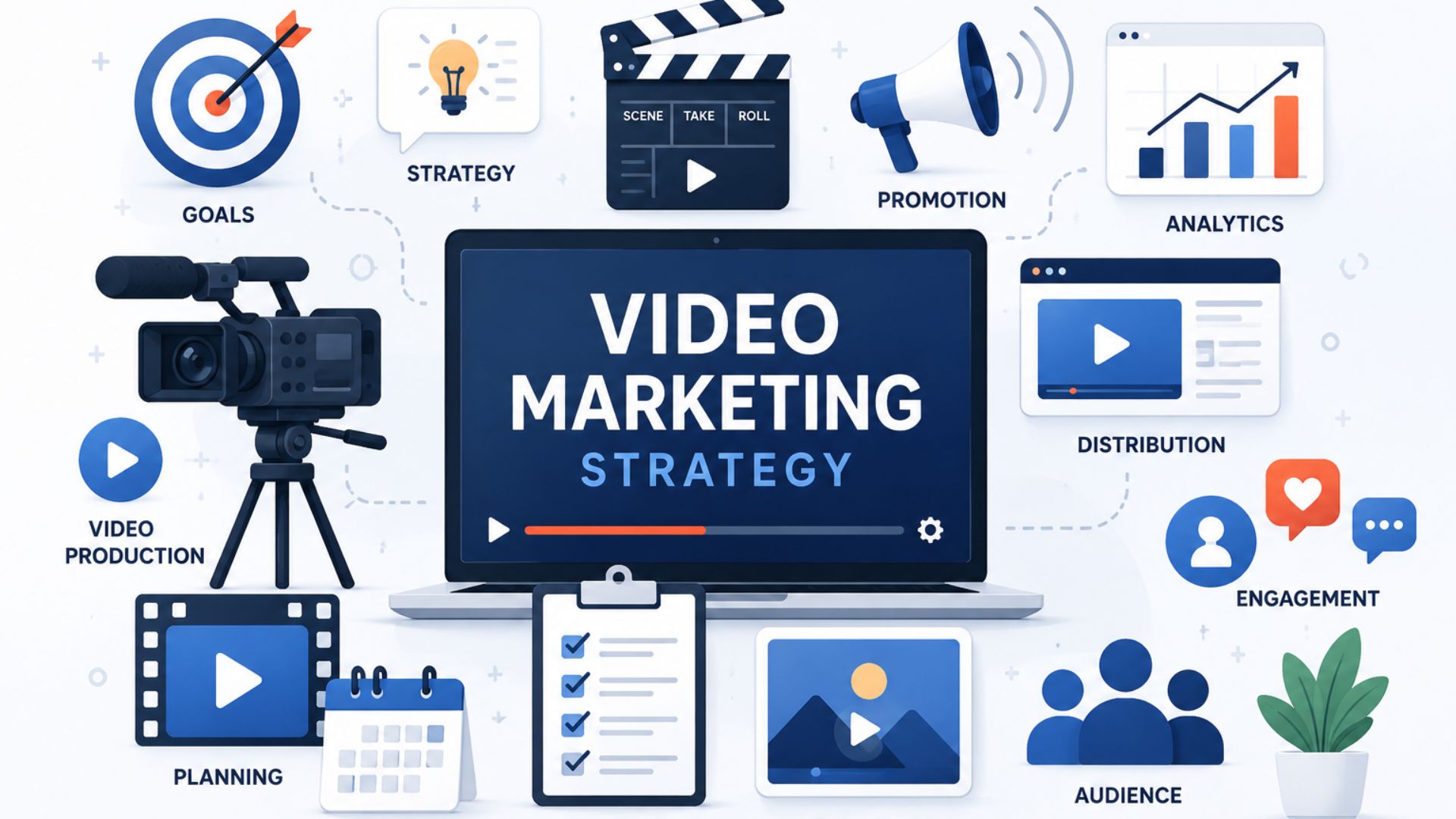
A video distribution strategy is the plan for where, when and how you will share your video content with the people you want to reach.
It covers much more than choosing between YouTube and LinkedIn.
A good strategy considers:
- Who the video is intended for
- Where that audience spends time
- What stage of the buying journey they are in
- Which platforms are most relevant
- Whether the video needs to be shortened or reformatted
- How it will support sales and marketing
- How often it should be promoted
- What results you will measure
This matters because even an excellent video can underperform if nobody sees it.
Businesses sometimes put significant effort into producing a corporate film, customer case study or product video, publish it on their website and share it once on LinkedIn.
Then nothing happens.
The problem may not be the video.
The problem may be the distribution.
Think of production as creating the asset and distribution as putting that asset to work.
Why Video Distribution Matters as Much as Production
A professionally produced video can represent a significant investment.
That makes it worth thinking beyond the initial launch.
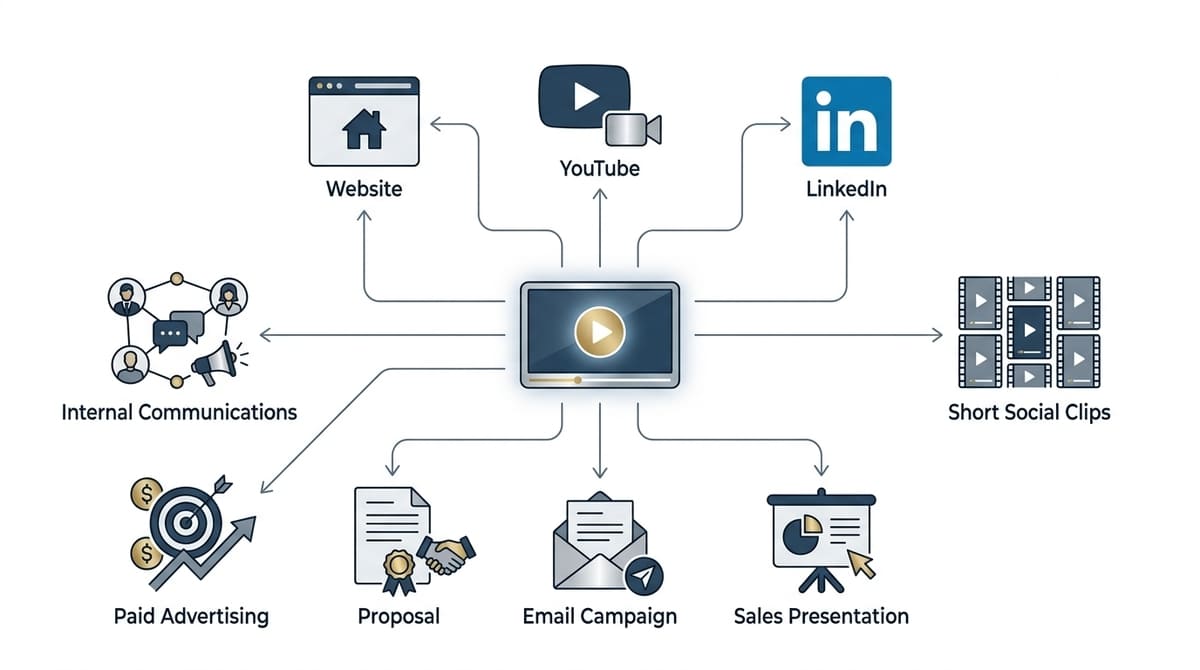
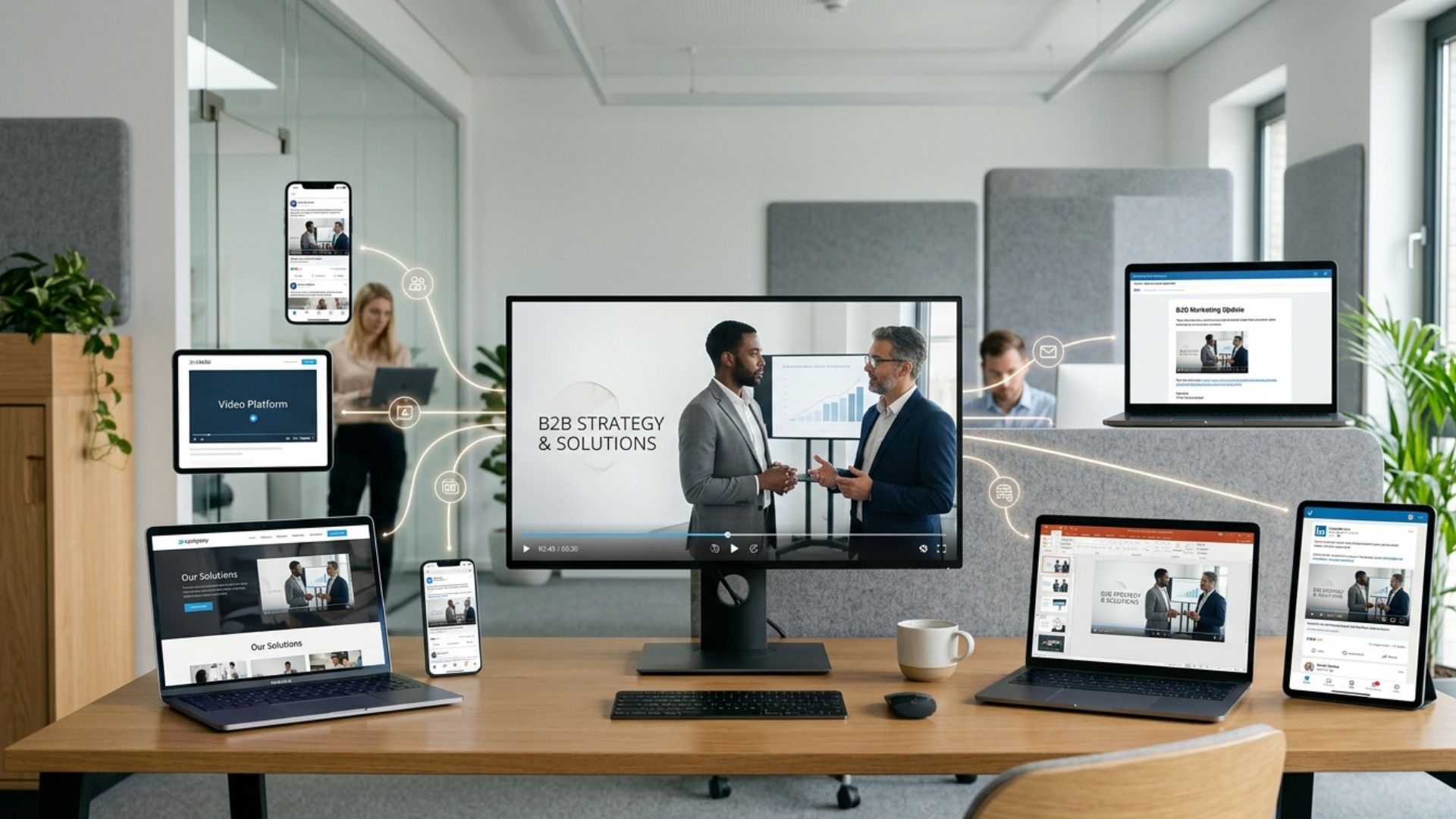
If you have created a three-minute customer case study, for example, there is no reason its only purpose should be to sit on one webpage.
The same production could potentially support:
- A website case study
- A YouTube upload
- LinkedIn posts
- Short social clips
- Sales presentations
- Email campaigns
- Proposal content
- Sales follow-ups
- Paid advertising
- Internal communications
One production can therefore become dozens of useful touchpoints.
This is particularly valuable for B2B businesses, where buyers rarely make a decision after seeing one piece of content.
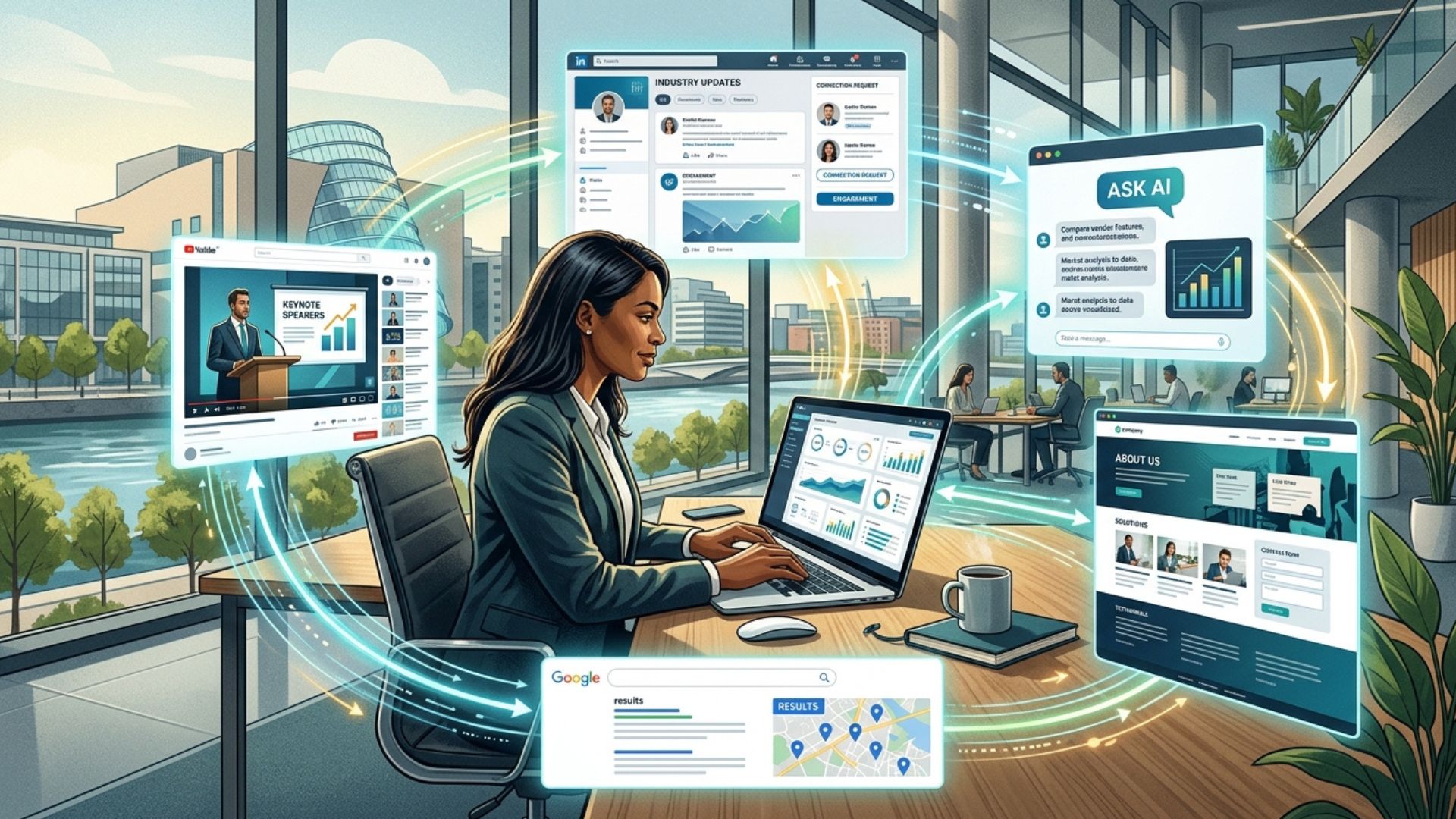
They may first discover your company through search, watch a video on LinkedIn, visit your website, receive a sales email and then see a customer story before deciding to speak with you.
Your video should be able to support that journey.
Start With the Audience, Not the Platform
One of the easiest mistakes is asking:
"Where should we post this video?"
The better question is:
"Where is the audience we want to reach, and what do they need from this video?"
Different audiences behave differently.
A prospective customer researching a technical solution may spend time on Google and YouTube.
A decision-maker researching suppliers may encounter your company through LinkedIn.
A prospect already speaking with your sales team may receive the video directly by email.
An employee candidate may find it through your careers page or recruitment campaign.
The same video can potentially work across several of these channels, but the way you present it should change depending on the situation.
From working with Irish businesses, we’ve found that the most effective video distribution plans start with the audience and buying journey, rather than simply trying to be present on every platform.
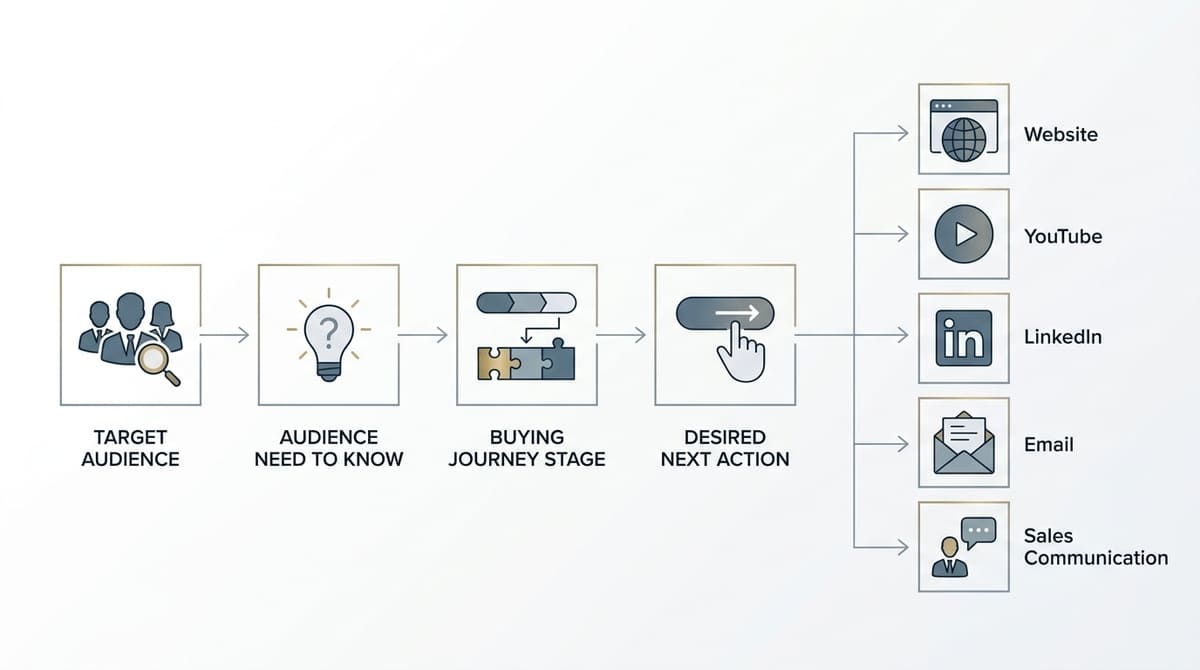
Before distributing a video, define:
Who is it for?
Be specific.
"Businesses" is not an audience.
A better audience might be:
- Marketing managers at Irish B2B companies
- Procurement teams in manufacturing
- HR leaders recruiting technical staff
- Prospective customers comparing suppliers
- Existing customers considering another service
What do they need to know?
Are they looking for proof, education, information or reassurance?
What should they do next?
Should they visit a webpage, contact sales, request a quote, watch another video or simply remember your brand?
These answers should shape the distribution plan.
1. Put the Video on the Right Page of Your Website
Your website should usually be one of the first places you consider.
But don't simply upload the video to your homepage because you have nowhere else to put it.
Think about search intent and context.
A product demonstration belongs on a relevant product or service page.
A customer case study belongs alongside the written case study.
A recruitment video belongs on the careers page.
A company overview might work well on the homepage or About page.
The video should help answer the question the visitor already has.
For example, someone landing on a service page may be wondering:
"Can this company actually deliver what I need?"
A relevant case study or demonstration can help answer that question much more effectively than a generic company film.
The placement also matters.
Don't hide an important video several clicks deep if it could help a visitor make a decision.
Make it easy to find, understand and watch.
2. Use YouTube as More Than a Video Archive
YouTube is often treated as a place to store finished videos.
It can be much more useful than that.
For many businesses, YouTube can act as part of their search strategy.
People use it to find:
- Product demonstrations
- How-to videos
- Technical explanations
- Company information
- Reviews and customer experiences
- Comparisons
- Industry advice
That means the title, description and surrounding content should reflect what someone might actually search for.
Instead of naming a video:
Company Video 2026
you might create a clearer title based on the subject:
How Our Manufacturing Process Works | [Company Name]
The goal is not to force keywords into every title.
It is to make the content understandable to both the viewer and the search engine.
A well-organised YouTube channel can also become a useful library that prospects can browse when researching your business.
3. Adapt the Video for LinkedIn
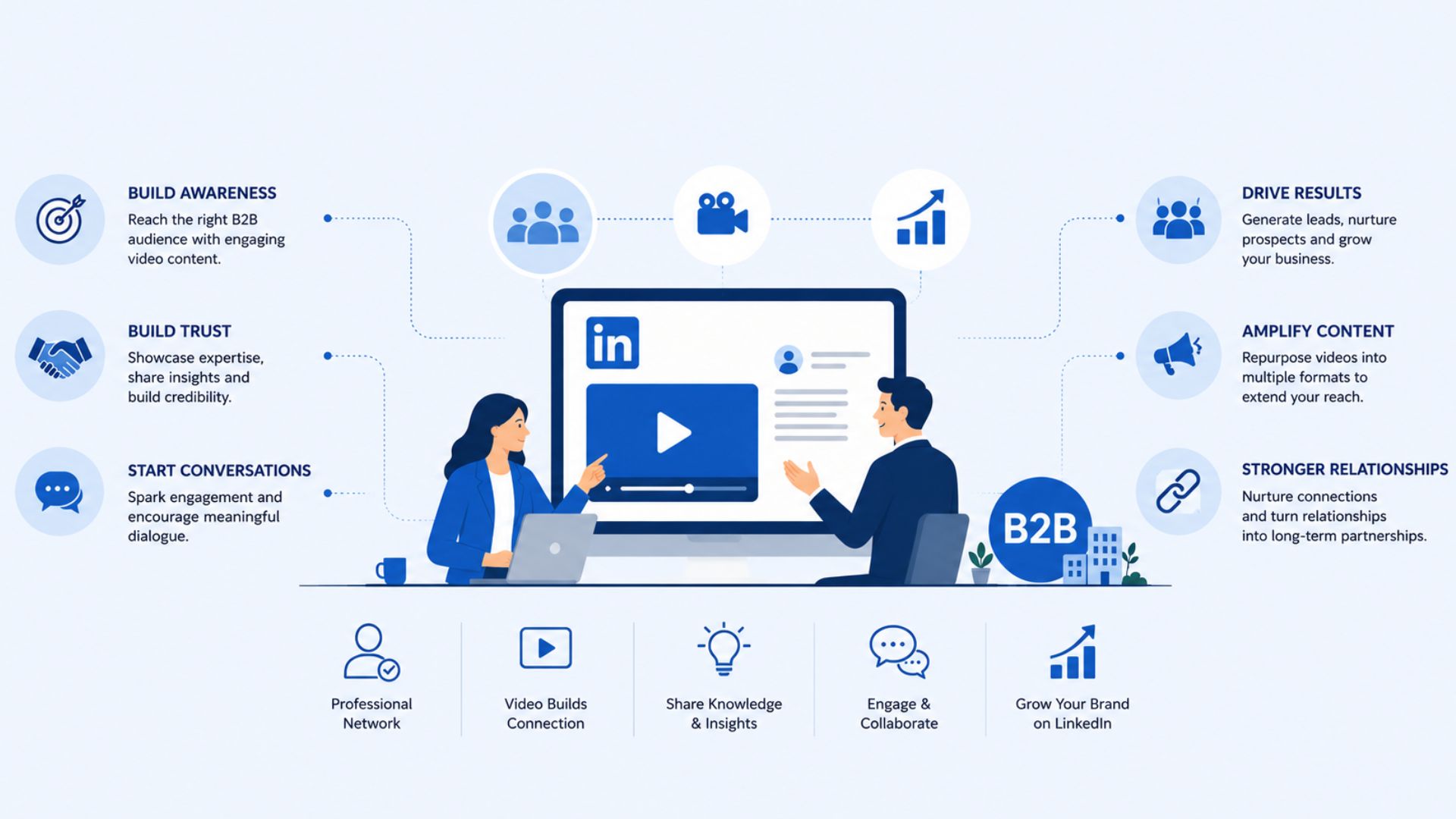
For B2B businesses, LinkedIn deserves more than a single launch post.
The mistake is often taking the full three-minute video, uploading it once and writing:
"Check out our latest video."
There is little reason for someone to stop scrolling.
Instead, identify the strongest moments.
A customer explaining a measurable result.
An engineer answering a common question.
A surprising insight.
A useful demonstration.
A strong statement from a company leader.
These moments can become individual LinkedIn posts or short clips.
The original production then becomes a source of multiple pieces of content.
You can also change the angle of each post.
One clip might focus on the customer problem.
Another might explain the solution.
Another might highlight the result.
Another might introduce the person behind the work.
The video does not need to be repeated in exactly the same way.
4. Create Short-Form Content From the Main Video
Short-form content is one of the easiest ways to extend the life of a larger production.
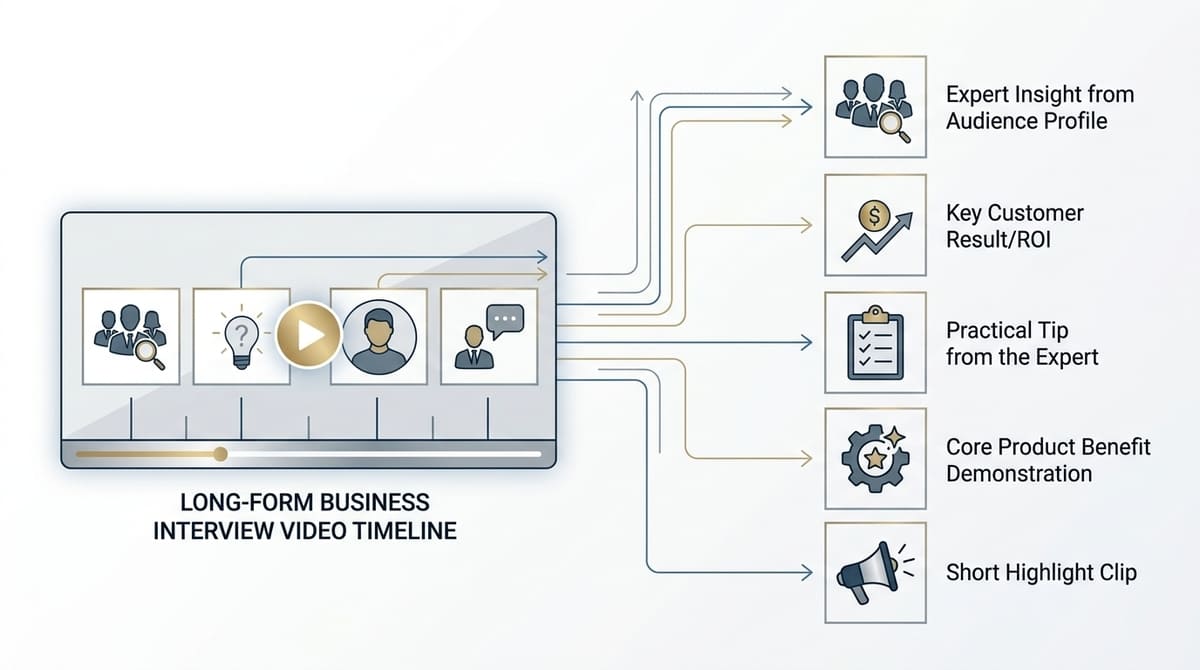
If you have filmed a 10-minute interview, for example, you may have several strong 20–60 second sections hidden inside it.
The key is to identify standalone ideas.
A useful clip should make sense without requiring the viewer to watch the full video first.
Good short-form clips might include:
- One customer result
- One practical tip
- One common mistake
- One product benefit
- One expert insight
- One interesting fact
- One strong customer quote
Add captions and make the opening seconds useful.
You are not simply cutting the original video into smaller pieces.
You are creating new entry points into the same story.
5. Use Video in Email Marketing
Email can give video content a very different role.
Instead of hoping someone discovers your video through a social feed, you can put it directly in front of an existing audience.
A customer case study might be included in a follow-up email.
A product demonstration could support a sales campaign.
A company video could introduce a new service.
An event recording could be sent to people who could not attend.
The important thing is relevance.
Don't send a video simply because you have one.
Ask:
Will this video help the recipient understand, evaluate or act on something?
If the answer is yes, it has a reason to be there.
You also do not necessarily need to embed the full video directly into the email.
A strong thumbnail, short introduction and clear link can encourage the recipient to watch it on your website or video platform.
6. Give Your Sales Team the Videos They Need
This is one of the most valuable distribution opportunities for B2B companies.
Sales teams often spend time answering the same questions repeatedly.
Video can help.
Imagine a prospect asks:
"How does your process work?"
Instead of sending a long explanation, the salesperson could share a short process video.
A prospect asks:
"Have you worked with companies like ours?"
Send a relevant customer case study.
A prospect is unsure how the product works.
Send the demonstration.
The video becomes part of the sales conversation rather than simply another marketing asset.
This is why distribution should involve the sales team from the beginning.
Ask them:
- What questions do prospects ask most often?
- Where do deals typically slow down?
- What objections come up repeatedly?
- What proof do prospects usually want?
- Which customers or projects would be useful examples?
Those answers can influence both what you film and how you distribute it.
7. Add Video to Proposals and Presentations
A video can also strengthen sales documents.
Instead of filling a proposal with paragraphs describing your capabilities, you can include a relevant customer story, product demonstration or company overview.
This gives the reader another way to understand the business.
The same applies to presentations.
A short video can break up a long slide deck and provide evidence that would be difficult to communicate through bullet points alone.
For example, a manufacturing company might use a 60-second facility video during a sales presentation.
An engineering business might demonstrate a product.
A professional services company might use a customer interview.
The content should support the argument being made at that point in the sales process.

8. Consider Paid Promotion for the Right Videos
Organic distribution is not always enough.
Some videos are particularly suitable for paid promotion because they support a clear commercial objective.
This might include:
- Product launches
- Lead-generation campaigns
- Event promotion
- Recruitment
- Brand awareness
- Retargeting
- New service launches
But paid promotion should not simply mean putting money behind your favourite video.
Consider the audience, offer, landing page and desired action.
A beautifully produced company overview may be useful for brand awareness but perform poorly as a direct-response advert.
A short product demonstration with a clear problem and solution may be much better suited to a campaign.
The video and the campaign need to work together.
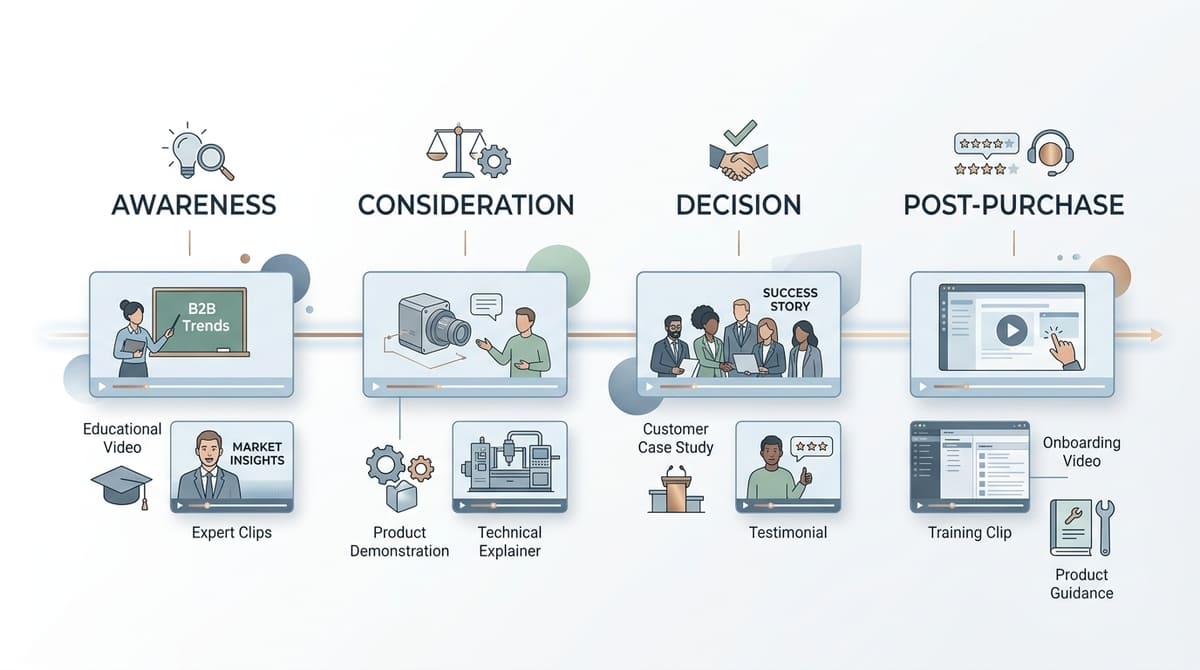
9. Use Video at Different Stages of the Buying Journey
Not every video should be shown to every prospect.
A useful distribution strategy considers where the viewer is in the buying process.
Awareness
The prospect may not know your company yet.
Useful content includes:
- Educational videos
- Industry insights
- Short expert clips
- Problem-focused videos
Consideration
The prospect understands the problem and is evaluating possible solutions.
Useful content includes:
- Product demonstrations
- Service explainers
- Company capability videos
- Technical content
Decision
The prospect is comparing suppliers and looking for reassurance.
Useful content includes:
- Customer case studies
- Testimonials
- Results-focused videos
- Detailed demonstrations
- Behind-the-scenes process videos
Post-purchase
The relationship does not end after the sale.
Useful content includes:
- Onboarding videos
- Training
- Product guidance
- Customer support content
- Updates
This approach makes distribution more strategic.
You are not asking, "Where can we put this video?"
You are asking, "Where can this video help the buyer next?"
10. Don't Forget Internal Distribution
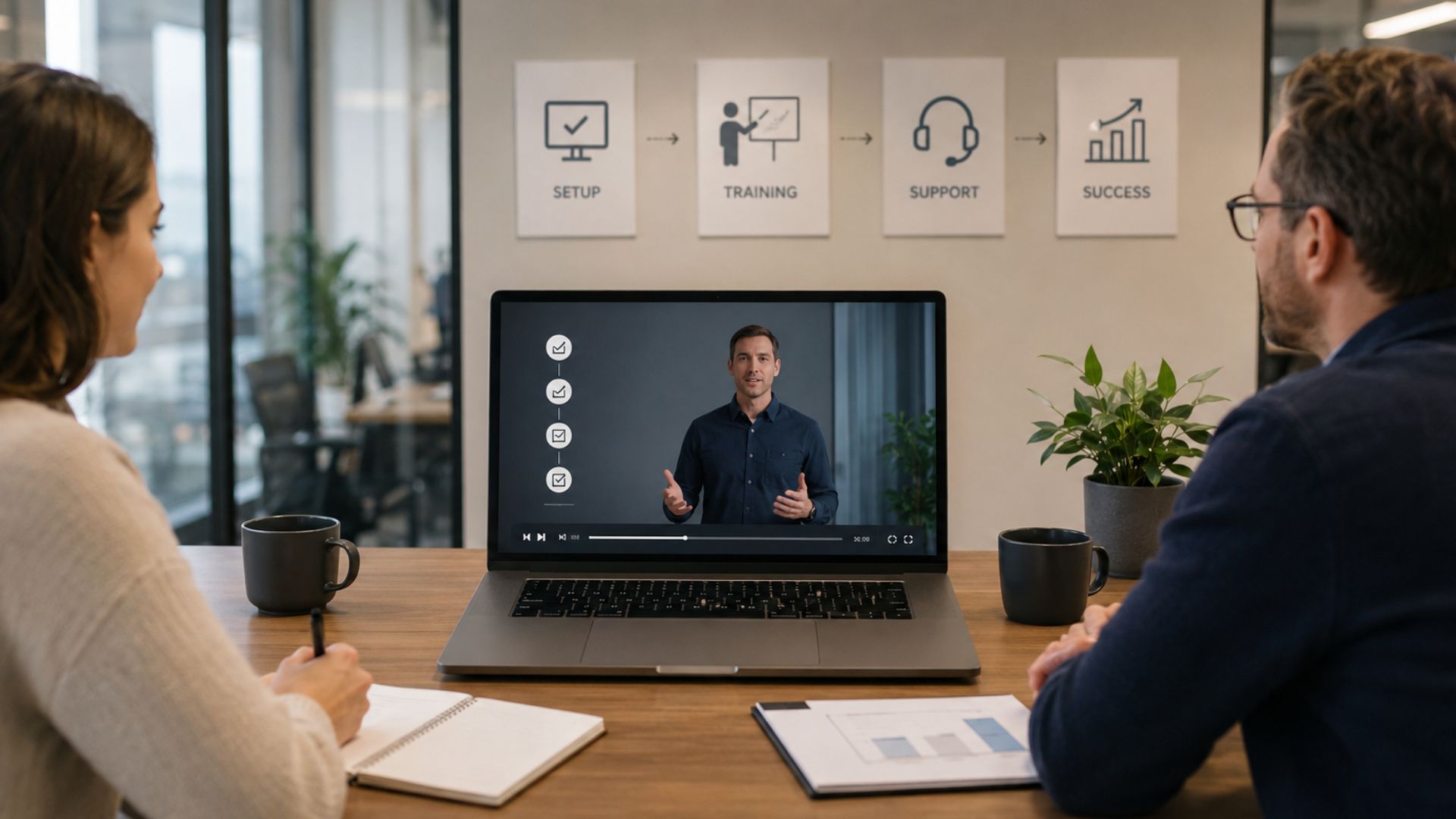
Some business videos are not intended for public marketing at all.
Internal video can support:
- Employee onboarding
- Training
- Internal announcements
- Process explanations
- Leadership communication
- Health and safety
- Company updates
This can be particularly useful for businesses with multiple offices, sites or teams.
A video can provide consistent information without requiring the same person to repeat the explanation to every group.
The distribution strategy should therefore consider the whole organisation, not just external marketing.
Image suggestion: Employees watching an internal training or leadership video on a laptop in a modern workplace.
Turn One Video Into a Content Campaign
The biggest opportunity after production is often repurposing.
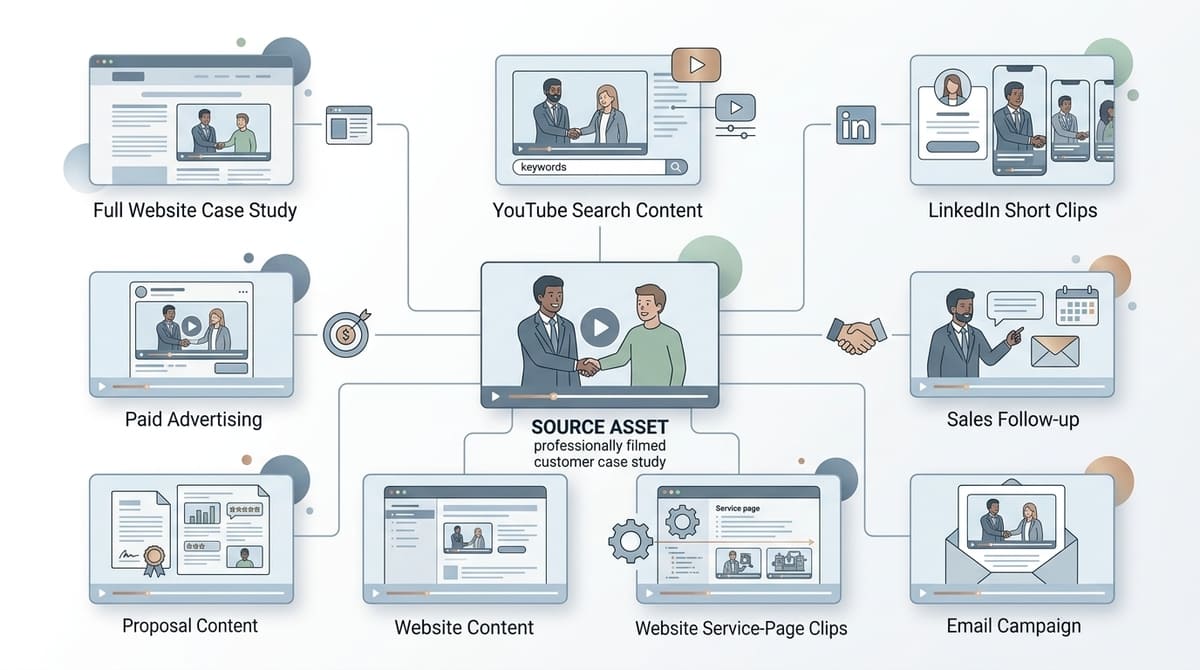
Imagine you have produced a customer case study.
You could distribute it as:
Main asset:
Full customer case study on your website.
Search:
YouTube version targeting the relevant topic.
LinkedIn:
Three short clips from the customer interview.
Sales:
A link for prospects evaluating your service.
Email:
A customer story included in a relevant campaign.
Website:
Shorter clips placed on service pages.
Proposal:
A relevant customer result included in a pitch.
Paid:
A short version targeting a specific audience.
One production has now become an entire campaign.
This is why it is worth thinking about distribution before the camera arrives.
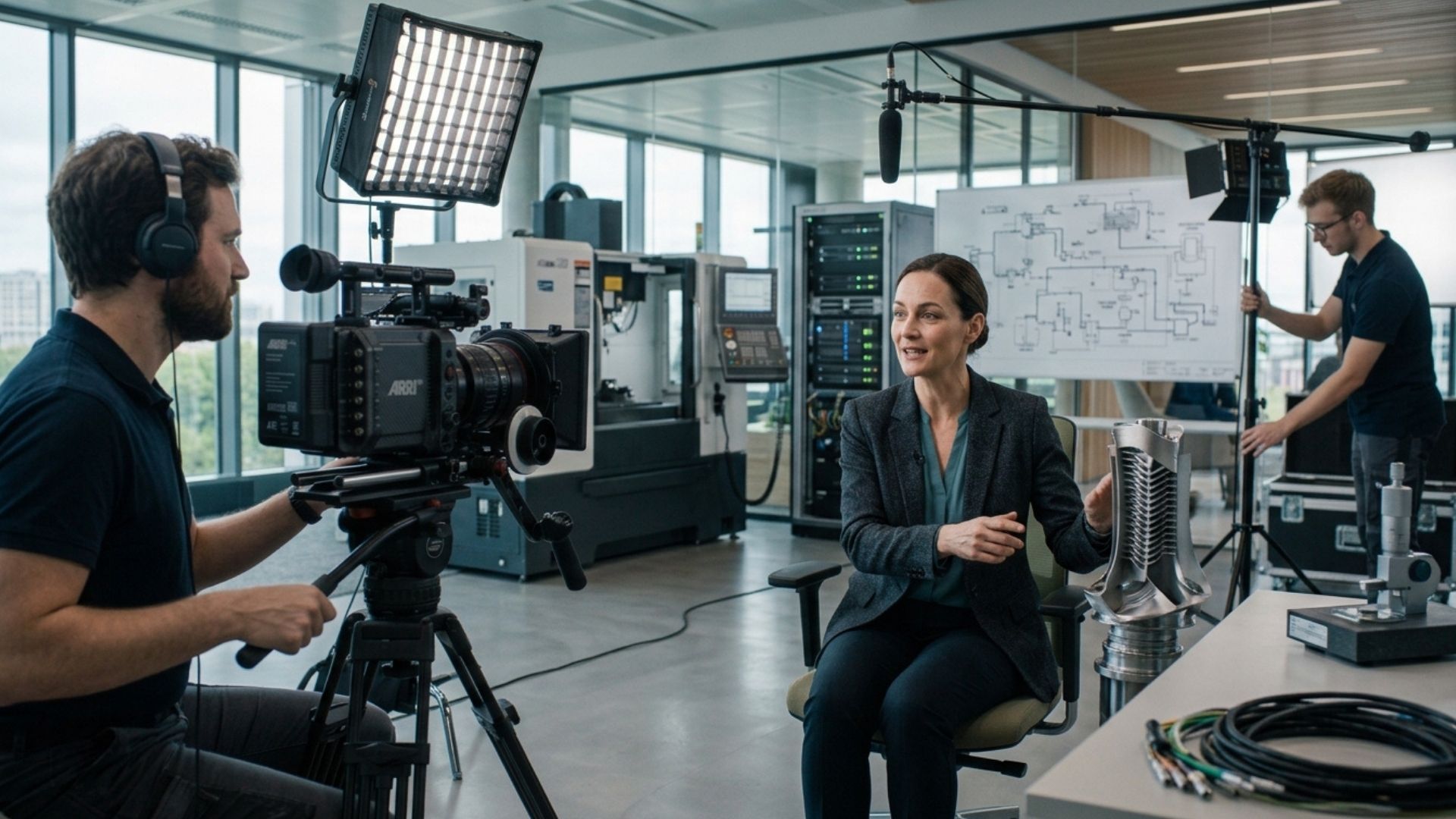
If you know you need vertical clips, interviews and short-form content, the production team can capture footage with those outputs in mind.
Build a Distribution Plan Before You Film
Distribution should not be an afterthought.
During pre-production, ask:
What will we do with this video after it is finished?
Create a simple plan covering:
Primary asset
What is the main video?
Primary audience
Who needs to see it?
Primary channel
Where is it most likely to have an impact?
Supporting channels
Where else can it be used?
Cut-downs
Which shorter clips should be created?
Sales use
Can sales teams use it in conversations or proposals?
Website use
Which page should feature it?
Measurement
What will success look like?
This planning can influence the filming itself.
You may need different interview questions.
You may need vertical footage.
You may need shorter statements.
You may need additional B-roll.
You may need versions with captions.
The earlier you decide this, the easier it becomes.

How Often Should You Promote a Business Video?
There is no universal schedule.
But one thing is certain:
Publishing once is rarely enough.
People miss posts.
Algorithms change.
New prospects discover your business every day.
A useful video can therefore be resurfaced in different ways over time.
For example:
- Launch the full video
- Share a key insight a few weeks later
- Publish a short clip
- Use another quote in a sales post
- Add it to a relevant webpage
- Include it in an email
- Revisit it when the topic becomes relevant again
This does not mean repeatedly posting the exact same thing.
It means finding new reasons for the content to be useful.
Evergreen videos can continue to support marketing long after the original publication date.
Measure More Than Views
Views are easy to understand, but they do not tell the whole story.
The right metrics depend on the purpose of the video.
For awareness content, you might look at:
- Reach
- Views
- Watch time
- Completion rate
- Engagement
For website content, consider:
- Page engagement
- Time on page
- Click-throughs
- Enquiries
- Conversion rate
For sales content, look at:
- Video usage by sales
- Prospect engagement
- Meetings influenced
- Opportunities supported
- Sales outcomes
For recruitment content, consider:
- Applications
- Careers-page engagement
- Candidate quality
- Recruitment campaign performance
The most important question is not:
"How many people watched it?"
It is:
"Did the video help us achieve what we created it for?"
A specialist B2B video viewed by 500 highly relevant prospects may be far more valuable than a generic video viewed by 50,000 people who will never become customers.
Common Video Distribution Mistakes
Uploading once and forgetting about it
A good video should have a longer life than one social post.
Using the same version everywhere
Different platforms and audiences often need different formats, lengths and messages.
Focusing only on social media
Your website, sales team, email campaigns and proposals can be just as valuable.
Creating content without a destination
Know what you want the viewer to do next.
Measuring views without business results
Reach matters, but relevance and outcomes matter more.
Waiting until the edit is finished to think about distribution
By then, opportunities for additional formats may already be lost.
Making every post promotional
Educational and useful content can create more engagement and trust than constantly asking people to buy.
What a Good Video Distribution Strategy Looks Like
A strong distribution strategy is not about being everywhere.
It is about being useful in the places that matter.
Your website may be the best home for the full video.
YouTube may help people discover it through search.
LinkedIn may introduce the strongest insight to new prospects.
Email may put a relevant case study directly in front of an active lead.
Sales may use the same video when a prospect reaches a specific stage of the buying process.
Each channel has a role.
The video becomes more valuable because it is connected to a wider system rather than existing as an isolated piece of content.
The Video Is Finished. The Work Isn't.
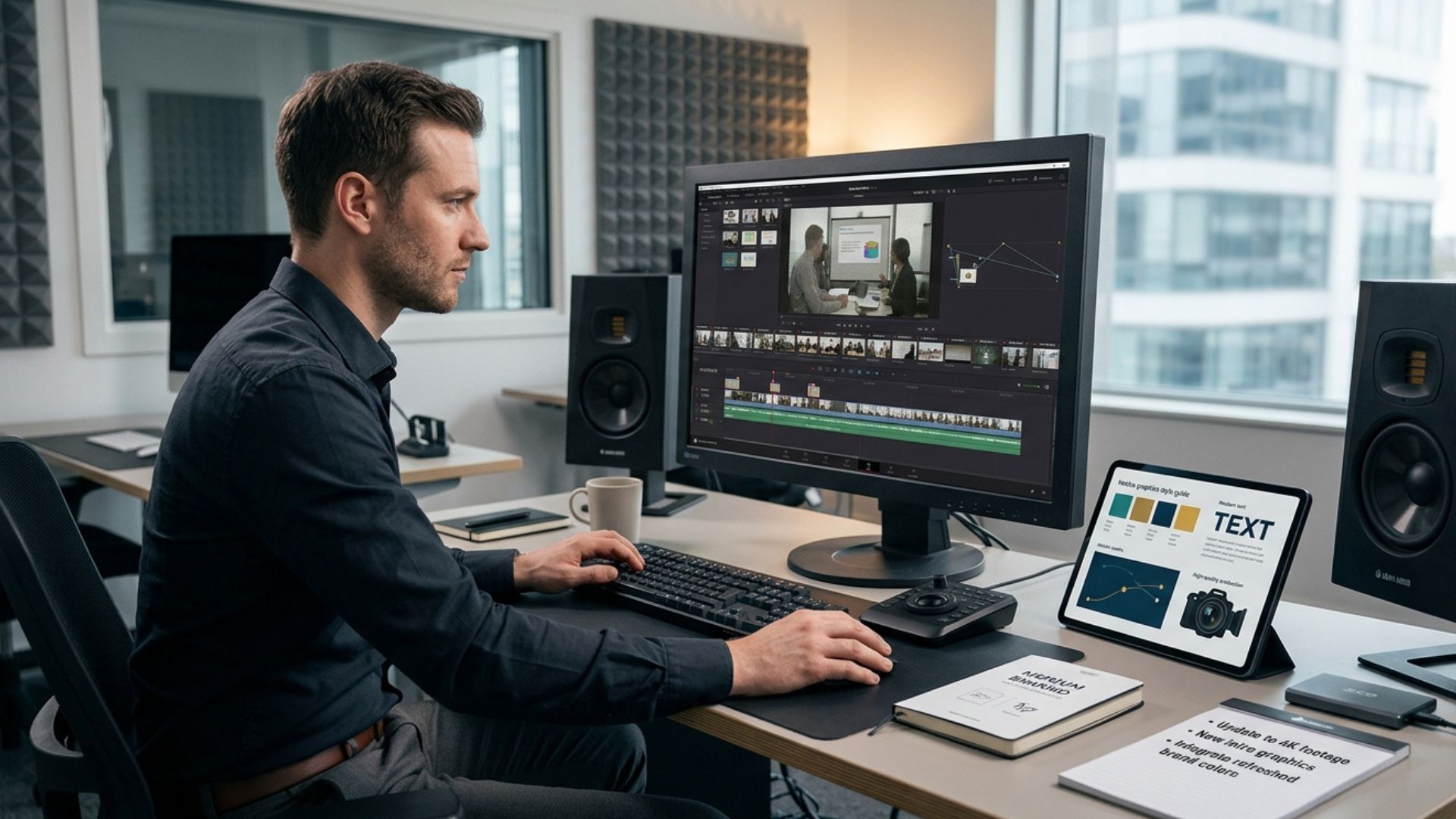
Finishing the edit is a milestone, not the end of the project.
The real opportunity begins when the video starts appearing in the places where your audience is already looking for information, proof and solutions. With the right distribution plan, one professionally produced video can support your website, search visibility, social content, sales conversations, email campaigns and future marketing for months or even years.
The best time to think about distribution is actually before production begins. When you know how the finished video needs to work, you can plan the shoot, interviews, B-roll and deliverables around that goal — creating content that is easier to repurpose and far more valuable once it is finished.
Ready to Put Your Video to Work?
If you’re planning a video, don’t wait until the final edit to think about where it will go. A clear distribution plan from the start can help you get more value from the production and create content that supports your marketing and sales long after launch.
Conclusion
A video should never be treated as finished simply because the final edit has been delivered. The real value comes from what happens next: putting that video in front of the right people, in the right places, at the right stage of their decision-making. One well-planned production can become far more than a single upload when it is built to support your wider marketing and sales activity.
If you're planning your next video, it is worth thinking about distribution before the cameras start rolling. Mango Media can help, you can explore our video production services, use the instant price calculator for an initial estimate, or get in touch for a free consultation.
Frequently Asked Questions
How do you distribute video content?
Video content can be distributed through your website, YouTube, LinkedIn, email campaigns, sales presentations, proposals and paid advertising. The best channels depend on your target audience, the purpose of the video and where your potential customers are in the buying journey.
Where should I post my business videos?
Start with the channels where your target audience is most likely to look for information. For many B2B businesses, this can include the company website, YouTube, LinkedIn and email, with sales teams also using relevant videos during the buying process.
How do I promote a video after it is published?
Don't rely on one launch post. Turn the video into shorter clips, quotes and insights, share them across relevant channels, add the main video to appropriate website pages and give sales teams versions they can use with prospects. This allows one video to keep generating value over time.
Similar blogs:


































![How to Write a Promo Video Script (Free Template Included) [2026 Guide]](https://cdn.prod.website-files.com/6226fcc37e2eb518b6e69a7f/69c3804c0b9ea78696bd89e0_covertab11.jpeg)





.jpg)
%20(1)%20(1).jpg)
.jpg)





We'd love to hear from you! Reach out to us today for a chat about our services, pricing, or just to say hello!


