
In today’s oversaturated inboxes, getting your email noticed — let alone opened — is no easy feat. In this article, we’ll explore the power of video in email campaigns, how to embed video content the right way, best practices to maximise performance, and how to track your results. Whether you’re a startup, marketer, or creative agency, using video in your emails can be a game-changer for audience retention and conversions.
Why Is Video Difficult for Professional Services Firms?
Professional services businesses have plenty of knowledge to share, but much of that knowledge is intangible.
An accountant can explain how a business should prepare for a major financial decision. A solicitor can explain a complicated legal process. A consultant can help a company solve an operational problem. An architect can explain the thinking behind a project.
None of those services is necessarily easy to film.
You cannot always point a camera at the thing being sold.
That can lead businesses towards the same predictable approach: film a partner or director sitting in an office, ask them to describe the company, add some footage of people working at laptops and finish with a logo.
There is nothing inherently wrong with that format, but it rarely makes the most of what professional services firms actually have.
Their expertise is the asset.
The challenge is finding ways to turn that expertise into useful, watchable visual content.
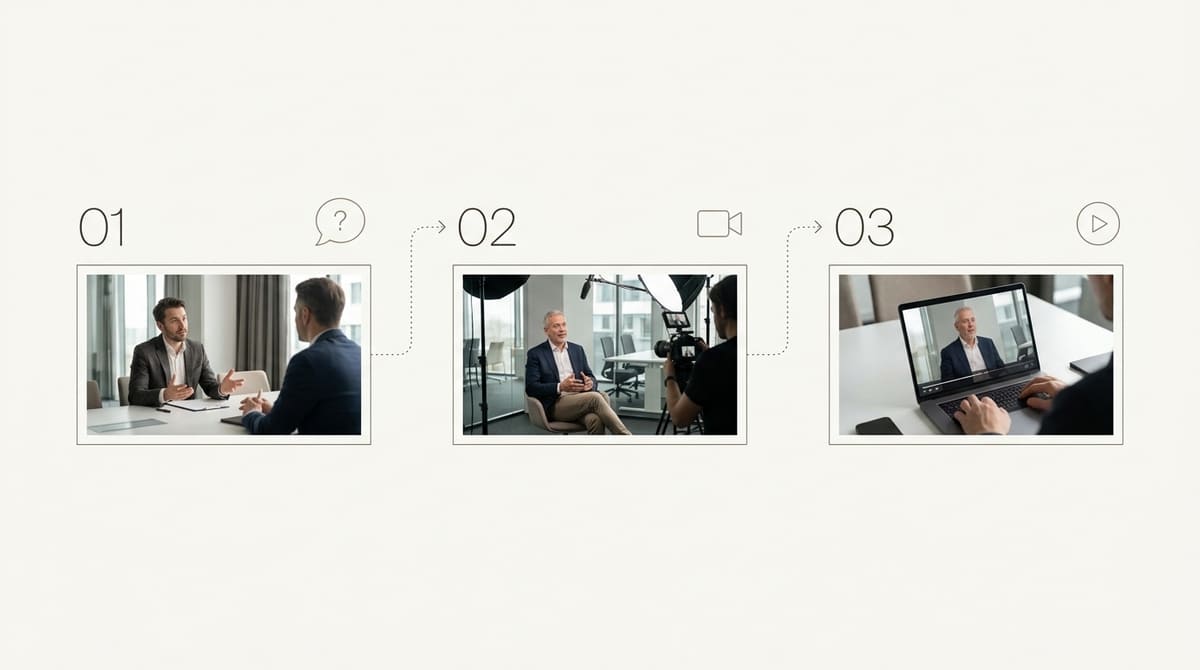
Start With What Your Clients Want to Know
The best starting point is not:
“What should we say about our company?”
Instead, ask:
“What questions do our clients ask us?”
Those questions are often the foundation of your strongest video content.
Think about the questions your team answers repeatedly during consultations, sales calls, meetings and email conversations.
For example:
- What should a business do before entering a new market?
- How can we reduce a particular business risk?
- What should we know before starting a major project?
- When should we seek professional advice?
- What mistakes do businesses commonly make?
- How does this process actually work?
- What should we consider before making this decision?
These questions can become individual videos.
That makes the content immediately more useful than a general company introduction because it starts with something the audience already cares about.

1. Film Expert-Led Videos
Your people are one of the most valuable things a professional services firm can put on camera.
Partners, consultants, advisers and specialists already have knowledge that clients want. The video simply gives that knowledge another format.
An expert-led video could answer one specific question in a few minutes.
For example:
Instead of:
“Meet Our Corporate Advisory Team”
Try:
“What Should a Business Check Before Acquiring Another Company?”
The second idea gives the viewer a reason to watch.
It also allows the expert to demonstrate knowledge without turning the video into a sales presentation.
This approach works particularly well when the subject is complex. A knowledgeable person can explain the issue while the production uses supporting visuals, graphics, B-roll or examples to make the information easier to follow.

2. Show How Your Service Actually Works
Professional services can sometimes feel abstract from the outside.
A potential client may understand what you offer but still have no idea what working with you actually involves.
Video can make that process more tangible.
Consider filming:
- How a project begins
- What happens during an initial consultation
- How information is gathered
- How your team approaches a problem
- How different specialists collaborate
- What happens between the first meeting and final delivery
- How you communicate with clients throughout a project
You do not need to reveal confidential information.
The aim is to give potential clients a better understanding of the experience of working with your business.
This can be particularly valuable for services where the process itself is part of the reason a client chooses one firm over another.

3. Turn Complex Services Into Simple Explanations
A professional services website can contain pages full of information.
But a visitor may still struggle to understand what a particular service actually means for them.
A short service explainer can help.
For example, rather than simply listing a specialist service, an expert could explain:
What is it?
Who needs it?
What problem does it solve?
What does the process involve?
What should a client prepare?
The goal is not to explain every detail.
It is to give someone enough context to understand whether the service is relevant to them and what they should do next.
This is especially useful for services involving unfamiliar terminology or multi-stage processes.
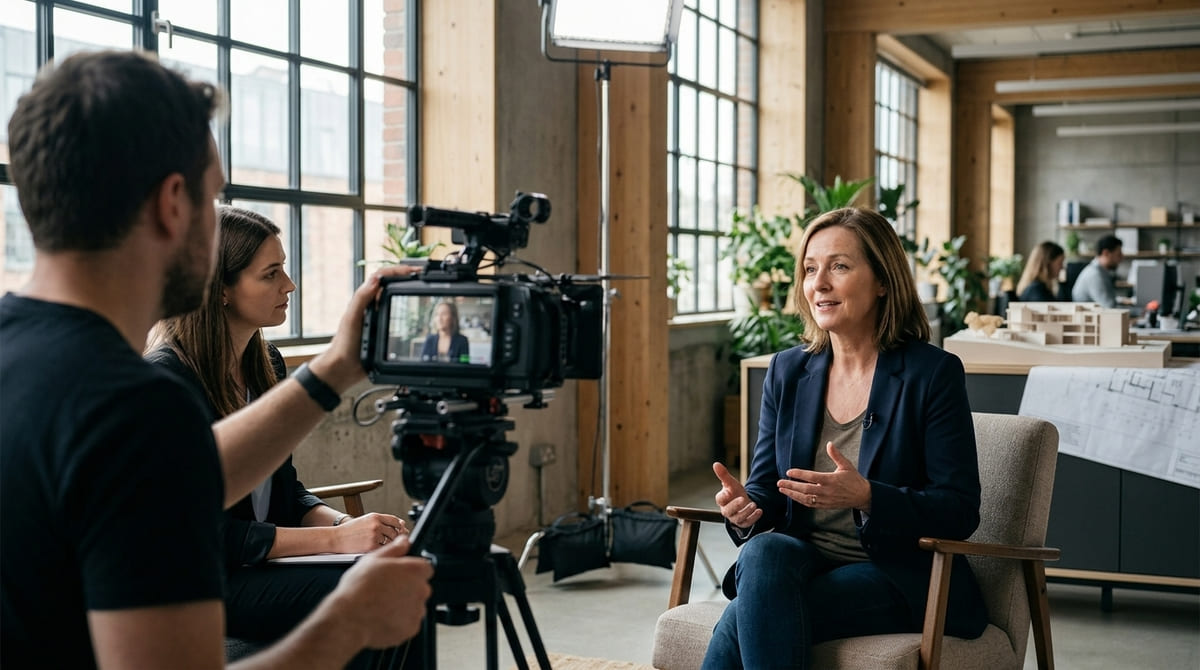
4. Film Client Case Studies
Professional services firms often rely heavily on trust.
A potential client may be asking:
“Have you dealt with a situation like ours before?”
A case study video can answer that question through someone else's experience.
Instead of explaining how good your firm is, allow a client to describe:
- The problem they faced
- Why they needed support
- What they were looking for
- How the project worked
- What the experience was like
- What changed afterwards
The client's story becomes the evidence.
This is particularly powerful for professional services because buyers are often purchasing judgement, experience and confidence rather than a tangible product.
A strong case study does not need to become a sales pitch. The more naturally the client can describe the challenge and outcome, the more credible the story can feel.
5. Show the People Behind the Business
Clients are not only choosing a company.
They are often choosing the people they will have to trust with important decisions.
That makes your team worth filming.
But this does not mean creating a series of identical staff profiles where everyone says the same thing.
Instead, look for opportunities to show personality and expertise.
A partner could explain why they chose their area of specialism.
A consultant could discuss a lesson they have learned from working with clients.
A junior team member could explain how they developed their career.
A project team could explain how they approach a complicated assignment.
The objective is to make the people behind the service more familiar before a potential client ever speaks to them.
6. Show Your Workplace Without Making It the Whole Story
Office footage has its place, but it should support the story rather than become the story.
Film your team working, discussing projects, preparing presentations, reviewing information or meeting with colleagues.
Capture the environment in a way that feels natural.
If your firm has multiple locations, specialist facilities or a distinctive working environment, those details may also be worth including.
But avoid relying on generic footage of people typing, answering phones and pointing at computer screens simply because it looks like “business video”.
The question should always be:
What does this shot help the viewer understand?
If the answer is nothing, you probably do not need it.

7. Show What Expertise Looks Like in Practice
One of the biggest advantages professional services firms have is the ability to solve problems.
That process can become useful video content.
Imagine filming a consultant working through a hypothetical business challenge.
Or an architect explaining how they approach the early stages of a project.
Or a financial adviser walking through the factors a business should consider before making a major decision.
Or a solicitor explaining the stages of a process using a simple visual example.
You are not giving away confidential client information.
You are showing how your expertise is applied.
This can help potential clients understand not only what you know, but how you think.
That distinction can be extremely valuable.
8. Use Real Examples Without Revealing Confidential Information
Professional services firms often hesitate to use video because their work involves sensitive client information.
That does not mean you have nothing to film.
You can use:
- Anonymised examples
- Hypothetical scenarios
- Publicly available information
- Generic process demonstrations
- Approved case studies
- Non-confidential project footage
- Recreated situations
- Diagrams and graphics
The production should be planned around confidentiality from the beginning.
If there are restrictions around what can appear on screen, your production team can work around them rather than discovering the problem during editing.
In some cases, a simple graphic or recreation can communicate an idea more effectively than filming a real client project anyway.
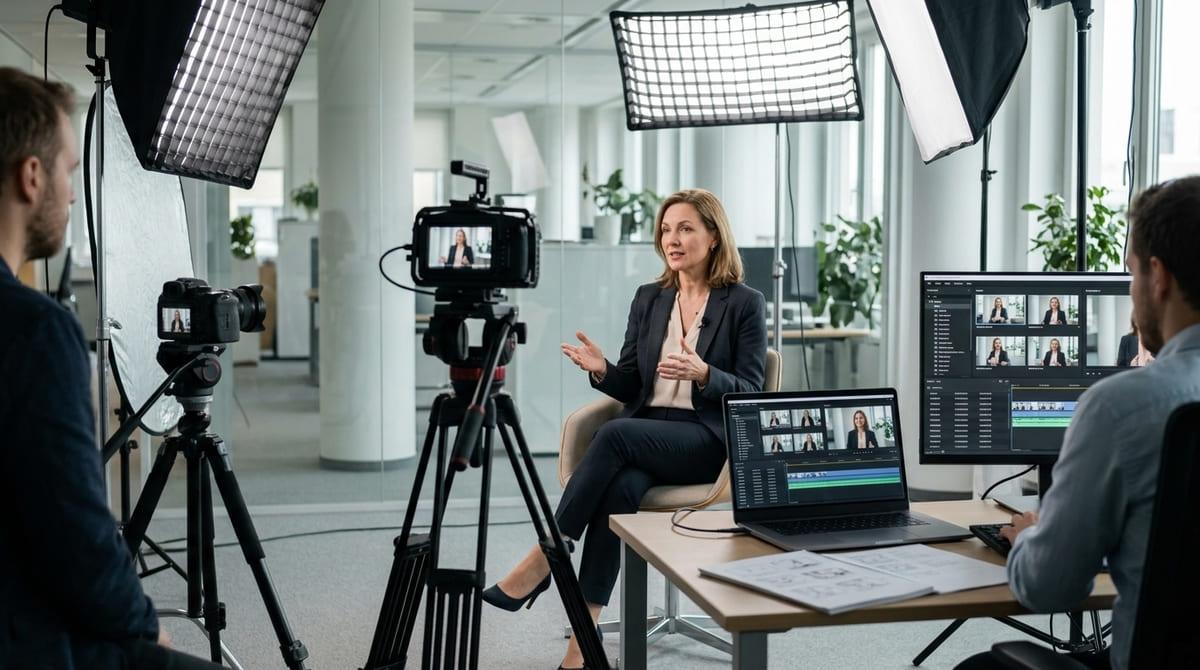
9. Film Frequently Asked Questions
Your sales and client-facing teams already know which questions come up repeatedly.
Turn those questions into a video series.
For example:
“How Long Does the Process Take?”
An expert can explain the typical stages and what can affect the timeline.
“When Should I Get Professional Advice?”
A short answer can help potential clients understand when your service becomes relevant.
“What Happens During the First Consultation?”
This can remove uncertainty before someone gets in touch.
“What Information Will You Need From Me?”
This makes the next step easier.
A collection of FAQ videos can become particularly useful across a website, sales process and social channels.
You also do not have to create all of them at once.
Start with the questions your team answers most frequently.
10. Make Your Experts Natural on Camera
Professional services experts are not necessarily professional presenters.
They do not need to become one.
Trying to make an experienced adviser memorise a long script can actually make the video less natural.
A better approach is often to use focused questions and talking points.
Ask:
“What is the biggest mistake businesses make here?”
Rather than:
“Please explain our company's approach to this service.”
Ask:
“What should a client understand before they start this process?”
Specific questions tend to produce specific answers.
The production team can then shape those answers through editing, B-roll, graphics and additional footage.
For Irish businesses we've worked with, we've found that giving experts enough structure to stay focused while allowing them to speak naturally often produces stronger material. The finished video feels professional without making the person sound like they have memorised a marketing script.
11. Don't Make Every Video a Sales Pitch
This is particularly important for professional services.
If every video ends with a long explanation of your services, the audience can quickly feel that they are being sold to.
Not every video needs to ask someone to book a consultation.
Some videos can simply answer a useful question.
Others can explain a complicated subject.
A case study can demonstrate what working with you looks like.
An expert video can give potential clients a useful perspective before they are ready to buy.
That does not mean the content has no commercial value.
Quite the opposite.
When a potential client repeatedly encounters useful information from your team, they begin to understand the expertise behind the business.
That familiarity can matter when they eventually need help.
12. Think Beyond the Main Corporate Video
Professional services firms often assume they need one large corporate film.
That can be useful, but it should not necessarily be the entire video strategy.
One production day could potentially create several different assets.
For example:
- A main company video
- Expert interview clips
- Service explainers
- FAQ videos
- Team introductions
- Short thought-leadership pieces
- Case study footage
- Website clips
- Social media cut-downs
The exact combination depends on the firm's goals.
The important point is to think about the content ecosystem before filming begins.
If you know that you need ten short videos as well as one main film, the production can be planned around capturing the right interviews and supporting footage in one session.
That can be considerably more efficient than organising separate shoots every time another content idea appears.
13. Choose the Right People to Put on Camera
The most senior person in the company is not automatically the best person for every video.
Choose people based on the subject.
The best person to explain a service may be the specialist who works with it every day.
The best person to discuss company culture may be an employee who can speak naturally about their experience.
The best person for a technical question may be someone who has solved that problem repeatedly.
Leadership can still play an important role, particularly when discussing company direction, values or major changes.
But credibility does not always come from job title.
Sometimes it comes from first-hand knowledge.
14. Make Professional Services Video Feel Human
Professional services marketing can easily become formal.
There is nothing wrong with professionalism, but professionalism does not require stiffness.
Your audience wants to know that your firm is capable.
They also want to know what it would actually be like to work with your people.
That means leaving room for personality.
Let an expert explain something in their own words.
Show colleagues interacting naturally.
Capture genuine moments rather than manufacturing every reaction.
Use locations that actually represent the business.
And avoid forcing every sentence into corporate language.
A polished video can still feel human.
In fact, that combination is often what makes professional services content work best.
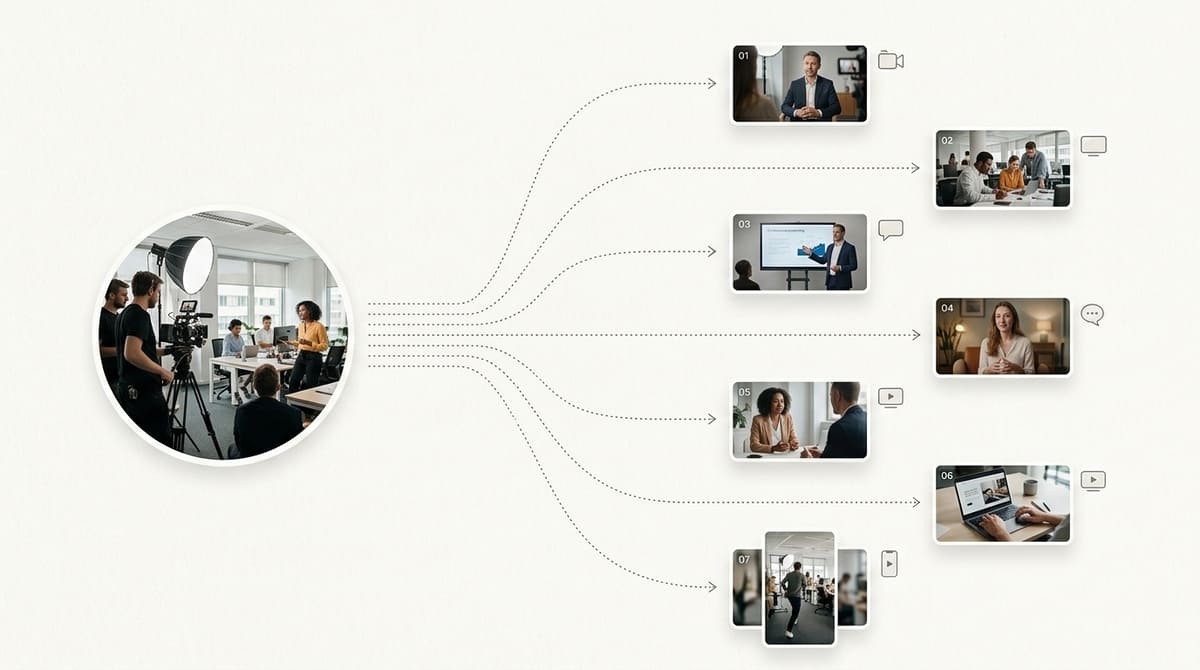
What Should You Film in One Production Day?
If your firm is planning a shoot, start by identifying the most valuable content before the cameras arrive.
A useful production plan might include:
Morning: expert interviews
Capture several focused conversations around client questions, services and areas of expertise.
Midday: workplace and team footage
Film people working, collaborating and moving through the normal environment.
Afternoon: service-specific footage
Capture demonstrations, meetings, presentations, diagrams, screens, project work or other visuals that help explain what the firm actually does.
Additional time: short-form content
Use the remaining interview time to capture concise answers that can become individual FAQ or social videos.
The exact schedule will depend on the business, but the principle is simple:
Do not leave the shoot without knowing what each piece of footage is supposed to be used for.
Build Your Video Around the Client, Not the Camera
The biggest mistake a professional services firm can make is starting with the equipment.
The camera is not the strategy.
The strategy starts with the audience.
What does your ideal client need to understand?
What are they uncertain about?
What questions are stopping them from getting in touch?
What expertise can your team demonstrate?
What evidence can you provide?
Once those questions are clear, the production becomes much easier to plan.
You can choose the right people, locations, questions, visuals and formats because you know what the content needs to accomplish.
Ready to Turn Your Expertise Into Video?
If your professional services firm has struggled to decide what to film, start with your clients rather than your services list. Look at the questions they ask, the problems they face and the parts of your process they may not understand, then identify the people inside your business who can explain those subjects clearly.
The goal is not to film everything your company does. It is to film the things that help the right audience understand why your expertise matters.
Conclusion
Professional services firms have more video opportunities than they often realise. Your expertise, people, client stories, processes and real-world experience can all become powerful content when they are built around what your audience actually wants to understand.
The goal isn't to film everything your business does. It's to show why your expertise matters. Mango Media can help turn that expertise into professional video content that supports your marketing, sales and wider business goals. Explore our video production services, use the instant price calculator for an initial estimate, or get in touch for a no-obligation conversation.
Frequently Asked Questions
What type of video is best for a professional services firm?
There is no single format that works for every firm. Expert-led videos, service explainers, client case studies, FAQ videos, team content and process videos can all be effective. The best format depends on what your audience needs to understand and where they are in the buying process.
What should a professional services firm include in a video?
Useful content can include expert interviews, client stories, workplace footage, service explanations, FAQs, process demonstrations and examples of how the firm's expertise is applied. The focus should be on information that helps potential clients understand the business and make a more informed decision.
How can professional services firms make video content more engaging?
Start with a question or problem the audience actually cares about rather than a general company introduction. Use knowledgeable people, real examples, relevant B-roll and clear language. Professional production can improve the viewing experience, but the content itself should remain useful, specific and natural.
Similar blogs:

























![How to Write a Promo Video Script (Free Template Included) [2026 Guide]](https://cdn.prod.website-files.com/6226fcc37e2eb518b6e69a7f/69c3804c0b9ea78696bd89e0_covertab11.jpeg)





.jpg)
%20(1)%20(1).jpg)
.jpg)






We'd love to hear from you! Reach out to us today for a chat about our services, pricing, or just to say hello!


